
Transcript
Announcer:
You’re listening to GLC on ReachMD. This activity is provided by Global Learning Collaborativeand is part of our MinuteCE curriculum.
Prior to beginning the activity, please be sure to review the faculty and commercial support disclosure statements as well as the learning objectives.
Dr. Burns:
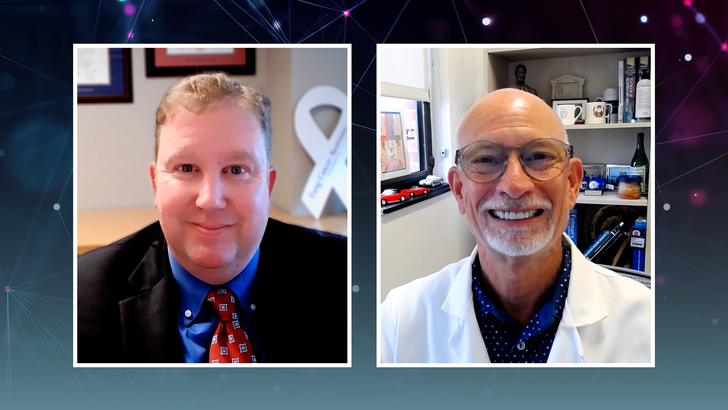
Welcome. This is CE with GLC, and I'm Dr. Timothy Burns.
Dr. Silvestri:
And I'm Dr. Gerard Silvestri.
Dr. Burns:
Dr. Silvestri, can you help our audience understand why trial readiness matters so much in KRAS G12C–advanced non-small cell lung cancer?
Dr. Silvestri:
Well, first of all, there's a lot of discrepancies between trial participation based on race and social status. What we really need is to make sure that we're enrolling patients in trials that include these populations so that we can generalize the results to them. What do we do with patients with poor performance status? Many of the trials that we currently have only include patients with 0 or 1 performance status, and we know that patients with KRAS G12C have a poor prognosis and that the current frontline standard of care is suboptimal. So we need better first-line options to improve patient outcomes.
I don't know how you approach this, Tim, but it's always been for me, into this for 30 years, a frustrating part of my career, which is A, how come more patients are not on clinical trials? We see less than 5% in lung cancer on clinical trials. And B, why those clinical trials aren't really expanded to include populations I want to know about.
Dr. Burns:
No, I think that's a great question. I think there's been a lot of efforts to really kind of expand trust kind of in the healthcare system and kind of underserved populations who traditionally have had poor experiences with clinical trials in the past. And I also think in lung cancer, especially in the last decade, there's just so much more that we can do. So there's so many more trials, and getting that word out that we can really make a difference, that many of the drugs we have today are because of these clinical trials.
And I think from a clinical trial perspective, and I think some companies are learning this, is trying to relax some of the guidelines. Like someone who has COPD who's on chronic oxygen at night should not be excluded, right? And doing things like patients with brain mets, if they're small, they can be untreated or they can be treated and the patient can go on the trial, or even just patients that get started in a community site and get a cycle of therapy are oftentimes excluded. But more and more trials are now allowing these patients, and I think it's going to be a little bit of everything to try to get as rid of as many barriers as possible, and also kind of encourage our patients that they can do significantly better on a clinical trial.
Dr. Silvestri:
That's great. What's your approach to matching patients with KRAS G12C to the right trial?
Dr. Burns:
I mean, I think the important thing is, as we've talked about in some other episodes, is really getting that molecular testing and getting that result. Many of our trials, obviously, are going to depend on having that data. And then once we know that, making sure that we find trials that allow brain mets, or if patients already had a cycle of therapy or may still be eligible for it. And so I think that's the key thing is just finding these patients and kind of working with our teams to do testing up front, whether it's in the early-stage setting or in the advanced setting, where I think and we're getting more and more of these KRAS G12C inhibitor trials.
Dr. Silvestri:
Yeah, and one thing I just want to alert our listening public to is there's this been always this idea that African Americans don't want to participate in these trials, and 25% of my state is African American, and we have not seen that. We know there's some general distrust, rightfully so, among that community, but we have not seen them—once it's explained to them what the trials have to offer, we've seen great participation from our African American community into our clinical trials, and actually an appreciation that we care enough to want to help them get a trial that might help both them and families in the future. So I want to make sure I make that point.
Dr. Burns:
Yeah, no, I agree. I think one of the things that's a disservice sometimes, or could be a disservice, is that we really should offer trials to everybody and explain why we think this may be the best thing for them. And I've had plenty of African American patients go on trials. I have one gentleman, he's on his third consecutive trial, and so I think we just need to reach out to everyone.
So I'll say, with that, I think our time is up. We hope you take these perspectives into your practice, and I want to thank everybody again for listening.
Announcer:
You have been listening to GLC on ReachMD. This activity is provided by Global Learning Collaborativeand is part of our MinuteCE curriculum.
To receive your free CE credit, or to download this activity, go to ReachMD.com/CME. Thank you for listening.
 In support of improving patient care, Global Learning Collaborative (GLC) is jointly accredited by the Accreditation Council for Continuing Medical Education (ACCME), the Accreditation Council for Pharmacy Education (ACPE), and the American Nurses Credentialing Center (ANCC) to provide continuing education for the healthcare team.

 Global Learning Collaborative (GLC) designates this activity for a maximum of 0.75 contact hour(s) (0.075 CEUs) of pharmacy continuing education credit.

